
St. John of the U.S Virgin Islands has a fascinating history and culture starting from its fiery volcanic birth.
St. John was once the site of a thriving Taino culture, a lucrative plantation era based on sugar and slavery followed by the subsistence economy of hard-working and industrious small farmers, artisans, and fishermen.
Today, St. John, USVI, is the home of the Virgin Islands National Park and is one of the most popular tourist destinations of those in the know. Here is a complete history of St John.
Complete Timeline of St John History
- 100,000,000 B.C. - Rocky core of St. John was first laid down on the ocean floor as a result of subterranean volcanic activity producing the same rocks found at Ram Head today.
- 15,000 B.C. - Glaciers lower the sea level by more than 300 feet and St. John became connected to Puerto Rico and the rest of the northern Virgin Islands. What is now an underwater ocean shelf were grasslands, savannas, and scrub forests.
- 5,000 B.C. - Melting of the glaciers results in the separation of the islands.
- 2,000 B.C. - People from the South American mainland begin a migration to the islands of the Lesser Antilles.
- 1,000 B.C. - First people arrive on St. John, surviving mainly on resources provided by the sea. They establish a village at Salt Pond Bay, collected and prepared seafood at Lameshur, and made stone tools at Grootpan Bay.
- 500 B.C. - The second wave of immigrants proceeds up the island chain arriving on St. John in the first century A.D. The original inhabitants are either killed or assimilated by the newcomers. These new arrivals are the ancestors of the Tainos, the culture that Columbus encountered when he arrived in the Americas.
- 65 A.D. - Amerindian Village established at Tutu on St. Thomas
- 180 - Village established near what is now Rothchild Francis Square on main Street on St. Thomas
- 600 - Villages established at Botany Bay, Magens Bay and Hull Bay, St. Thomas
- 1000 - The Taino culture that originated in Hispaniola arrives on St. Thomas and St. John.
- 1000-1492 - Tainos live peacefully on St. John, planting yucca, fishing, gathering wild fruit, fabricating ceramic pottery, tools, and ceremonial objects. Having little need for great technological advances or to defend themselves from other human beings, their culture concentrates on religious and spiritual development. The Tainos apparently disappear from St. John sometime before 1492.
- 1493 - Part of Columbus's fleet sails by St. John his second voyage. The island is reported to be uninhabited.
- 1593-1717 - St. John is sparsely and intermittently inhabited by small groups of Native Americans fleeing persecution, pirates, fugitives of all sorts and colors, fishermen and woodcutters.
- 1595 - Sir Francis Drake stops in St. Thomas to rest his troops before their unsuccessful raid on San Juan, after which the famed privateer dies of dysentery.
- 1598 - The Earl of Cumberland stops in St. Thomas on his way to a successful raid on San Juan. He reports the Virgin Islands to be unpopulated at the time.
- 1665 - King Frederik III of Denmark grants permission to a consortium led by Erik Nielsen Smit to settle St. Thomas
- 1666 - First expedition sails to St. Thomas. The cast of characters included about 50 people of varying European nationalities. They are joined by Dutch refugees who had been living on Tortola, who had been driven out by British privateers. These early settlers began the construction of a fort on what is now called Bluebeard's hill. The high mortality from disease, hunger, and raids by buccaneers who stole a ship and much of their supplies causes this first expedition to end in failure. Survivors sailed back to Denmark
- 1672 - Danes settle in St. Thomas. Construction of the Fort Christian (Christian's Fort) begins along with other buildings, plantations, and an east west road. The high mortality rate and the unwillingness of Danes to settle St. Thomas led Iverson to encourage settlement by inhabitants of neighboring islands, most of whom were either Dutch or English
- 1673 - Danish West India Company, which held the monopoly on the Danish slave trade, brought the first Africans to St. Thomas as slaves.
- 1674 - Governor Iverson acquired the enslaved worker, Simon Lamare. A talented mason, Lamare is offered a contract to act as "clerk of the works," overseeing the construction of Fort Christian. In return, Lamare is granted freedom after seven years of service, beginning, right from the start of the colony, the establishment a of free black and mixed race component of St. Thomas society
- 1678 - Soldiers at Fort Christian repel an attack by the French
- 1679 – 1686 - St. Thomas, under the governorships of the brothers Adolph and Nicolay Esmit and Gabriel Milan, has reputation for being a pirate haven
- 1680 - St. Thomas Governor Iverson resigns and leaves St. Thomas. Fort built and plantations begun. Population 156 whites and 175 blacks. 50 plantations and an east-west road.Population: 156 whites, 175 blacks, 50 plantations producing cotton, sugar, tobacco, indigo, and other tropical products
- 1683 - Iverson is reappointed as Governor but is thrown overboard on the voyage from Copenhagen to St. Thomas by mutineers, who also shot the captain, decapitated seven officers, and marooned the remaining representatives of the Company.
- 1684 - English thwart Danish attempts to settle St. John.
- 1685 - Brandenburg Company granted a 30-tear lease on land located on the western end of St. Thomas Harbor, St. Thomas became a transshipment point for slaves brought from Africa
- 1690 - Major earthquake and tsunami is recorded, possibly on the scale of the earthquake and tsunami of 1867
- 1697 - First recorded major hurricane. Danish West India Company takes over the slave trade from the Brandengburgers
- 1698 - Amnesty declared for pirates with the exception of Captain Kidd
- 1699 - Upon the arrival of Captain Kidd to St. Thomas, the Governor refused to give him protection and did not allow Kidd to come ashore.
- 1713 - Major hurricane recorded
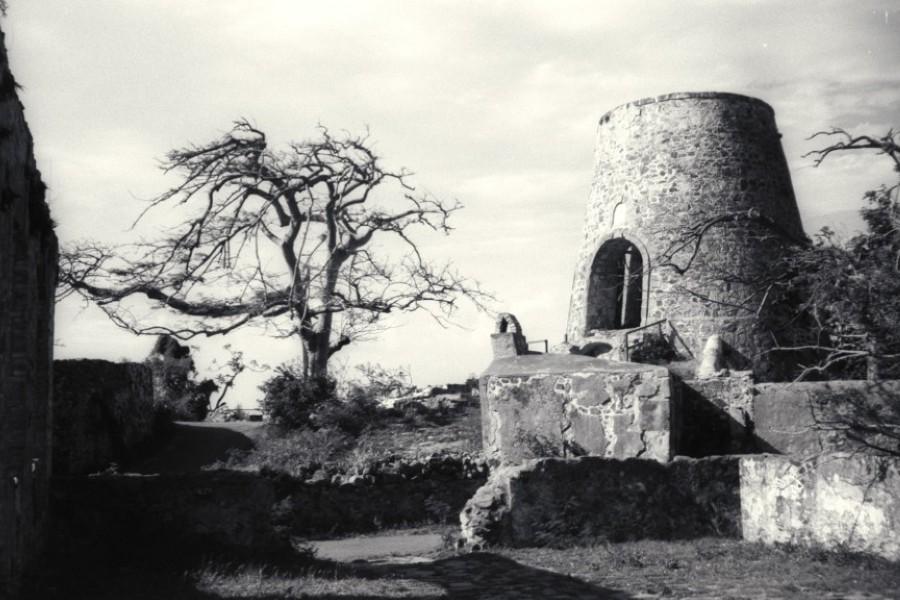
- 1718 - March 23, Erik Bredal, the Governor of St. Thomas publishes his intent to settle St. John. The next day, March 24, Bridal accompanied by 20 planters, five soldiers, and 16 enslaved Africans sailed from St. Thomas and landed in Coral Bay. On March 25, Bredal takes formal possession of St. John in the name of the King of Denmark and the Danish West India Company. He raises the Danish Flag and begins the construction of a fort. The plantation era begins on St. John. Using the labor of enslaved Africans, the forests are cleared, hillsides are terraced, and land is planted in sugar, cotton, and other tropical products.
- 1726 - Lutheran Pastor, Philip Adams Dietrich, performs the first Hurricane Intercessory Service in July and the first Hurricane Thanksgiving Service at the end of the hurricane season (July 25, Hurricane Supplication Day, and October 25, Hurricane Thanksgiving Day, are now official public holidays.
- 1728 - Population: 123 whites, 677 blacks on 87 plantations.
- 1733 - Population: 208 whites, 1,087 blacks on 109 plantations. St John is the victim of a severe drought, insect plague, and devastating hurricane. September 5, a merciless slave code was imposed. November 23, Africans from the Akwamu Nation, who had been brought to St. John as slaves, revolted against the owners and managers of the St. John plantations. Capturing the fort in Coral Bay, the rebels proceed to take control of most of the island, with the exception of Caneel Bay.
- 1734 - After several unsuccessful attempts to quell rebellion, the Akwamus is finally defeated by specially-trained French troops were sent from Martinique.
- 1738 - Major hurricane recorded
- 1742 - Major hurricane recorded
- 1739 - The plantation system on St. John returns to the pre-rebellion levels, 208 whites, and 1,414 blacks on 109 plantations.
- 1742 - Major hurricane recorded
- 1755 - King Frederick of Denmark buys all the land, slaves, estates, ships, factories, and everything else that was owned by the Danish West India Company and brought company rule of St. John and the rest of the Danish West Indies to an end. He issues the Reglement of 1755, in which slave rights were mentioned for the first time. (The document is never published on St. John.)
- 1766 - St. John and St. Thomas are declared free ports by the Danish Crown. Plans are made to begin the development of a town. The land is divided up into town lots but hoped-for development never materializes, and St. John remains primarily rural until the recent growth of tourism.
- 1772 - Major hurricane recorded
- 1773 - Population: 2,330 slaves and 104 whites on 69 plantations, 42 of which are devoted to cotton.
- 1787 - School ordinance issued by the Danish Government marks the first attempt to provide public education for both free and enslaved children in the Danish West Indies
- 1782 - H.M.S. Santa Monica hits a rock and is beached at Round Bay, East End.
- 1783 - Moravians establish a mission at Emmaus.
- 1792 - Danes pass a law mandating the end the African slave trade in ten years.
- 1793 - Major hurricane recorded
- 1800 - St. Thomas blockaded by British naval vessels
- 1801 - Three-month British occupation.
- 1802 - Law outlawing slave trade goes into effect in the Danish West Indies, making Denmark the first European nation to abolish the slave trade. 123,000 slaves had already been brought to the D.W.I. from Africa. Slave trade continues sporadically until the 1820s, when the law is more rigidly enforced.
- 1804 - Major fires sweep through Charlotte Amalie
- 1807-1815 - British reoccupy St. John.
- 1819 - Major hurricane recorded
- 1834 - Emancipation of slaves in the British Virgin Islands offer St. John slaves an excellent escape opportunity to nearby Tortola.
- 1836 - Major hurricane recorded
- 1839 - Governor-General Peter von Sholten put forth a proposal to provide free, compulsory education for children of enslaved workers in the colony. Classes are taught in English.
- 1840 - Major escape to the British Virgin Islands by slaves from Leinster Bay and Annaberg Plantation. It's followed a few days later by slave escape from Adrian, Brown Bay, and Hermitage.
- 1841 – 1850 - The maritime industry and related businesses thrive on St. Thomas. Undersea cable is laid between Britain and St. Thomas, a coaling station and shipyard are established on the island.
- 1841 - St. John's population reaches it's (pre-modern day) high point of 2,555. St. Thomas becomes a hub for the distribution of mail, money, and passengers to and from other Caribbean islands.
- 1841 - An agreement is reached between the Moravian Church and the Royal Council of St. Thomas and St. John to provide free compulsory education for all free-colored children. Classes are taught at both the Bethany and Emmaus missions.
- 1844 - Construction of the Annaberg Country School.
- 1845 - First Country School on St. John is completed at Beverhoutsberg
- 1846 - Population: 2450, 1790 slaves, 660 free (including whites).
- 1847 - Annaberg Country School was completed, but left vacant due to a lack of funds and opposition of the planter class.
- 1848 - On July 3, the emancipation of slaves in the Danish West Indies is established. July 4, news reaches St. John. On July 5, a police placard is posted in Cruz Bay prohibiting the "freed" from leaving the island. On July 10, police placard posted in Cruz Bay compelled the freed to sign labor contracts with their former owners.
- 1849 - Labor Act forced freed slaves to stay on plantations.
- 1850 – 1917 - Economic decline due to competition from sugar beets and islands better suited to sugar cane production, labor problems, and natural disasters
- 1852 - Moravians open a school on the East End to service the growing population there
- 1853 - Cholera epidemic kills 1,865 people Malaria kills 100
- 1854 - Cholera epidemic kills 218.
- 1855 - Population declines to 1,715.
- 1856 - Classes begin to be taught at the Annaberg Country School. Two more cholera epidemics ravage the population.
- 1859 - Moravians stop baptizing children born out of wedlock.
- 1862 - East End School was constructed.
- 1865 - St. Thomas Gas Company begins to provide illumination for streetlights, stores, and offices. Construction begins on Government House supervised by black Virgin Islander John Wright. Construction was completed in 1867
- 1866 - Cholera epidemic kills 1,300
- 1867 - Devastating hurricane followed by an earthquake severely damages estates and crops, effectively ending the plantation system and discouraging U.S. plans to purchase the islands.
- 1868 - 205 Danish West Indian voters unanimously support a U.S. purchase of the islands. U.S. rejects the purchase of St. Thomas and St. John from Denmark for $7.5 million.
- 1871 - Major hurricane recorded
- 1878 - Mary Thomas (Queen Mary) led the rebellion of disgruntled workers on St. Croix. Carolina Plantation in Coral Bay was acquired by William Henry Marsh.
- 1879 - Labor Act amended to allow contract negotiation. Bandstand erected at Emancipation Park
- 1880 - Widow George rents rooms by the night at in her house at Newfound Bay. Population declines to 994.
- 1885 - Royal Mail Steam Packet Company moves headquarters to Barbados
- 1898 - Major hurricane recorded
- 1900 - Population 925.
- 1902 - Denmark rejects U. S. offer to buy St. Thomas, St. John, and St. Croix for $5 million.
- 1907 - J.P. Jorgenson writes the Short Guide to St. Thomas and St. Jan, a travel guide written in English.
- 1914 - West India Company Ltd introduces electric lighting.
- 1916 - Major hurricane recorded
- 1917 - March 31, the official transfer of Danish West Indies to U.S. for $25,000,000. Virgin Islands are put in charge of the U.S. Navy.
- 1918 - Reef Bay factory closing ends sugar production.
- 1921 - United States Virgin Island flag designed and approved by U.S. Navy brass is adopted.
- 1924 - Major hurricane recorded
- 1927 - Virgin Islanders were granted American citizenship.
- 1928 - On his solo flight from Paris to the United States, aviator Charles Lindbergh landed on a field near what was then called Mosquito Bay. The bay was renamed was subsequently renamed Lindbergh Bay to commemorate the occasion. Major hurricane recorded
- 1929 - Erva and Paul Boulon Sr. buy Trunk Bay and 100 additional acres of land for $2,500.
- 1930 - Population of St. John is 756. The first automobile arrives on St. John. St. Thomas Daily News was founded. Navy rule ends. Average wage in Virgin Islands is 40 cents a day.
- 1931 - First civilian governor, Dr. Paul M. Pearson.
- 1934 - Eleanor Roosevelt wrote an article about her trip to St. Thomas and the Caribbean in "Women's Home Companion." Government-run Bluebeards Castle Hotel opens.
- 1935 - Edna St. Vincent Millay spends summer in St. Thomas in house at the top of the 99 Steps. The locally made mahogany "charge desk" at the Enid M. Baa Public Library on dedicated to the eminent poet.
- 1936 - First Organic Act passed by U.S. Congress giving political power to the local Virgin Islands government. Danish West India Company opens Caneel Bay Resort.
- 1939 - St. John, mentioned by Harold Huber of the National Park Service in the N.P.S. report as a possible park. The onset of World War II caused the plan to be shelved.
- 1946 - Robert and Nancy Gibney come to St. John on Honeymoon.
- 1948 - First jeep was brought to the island on a sloop from St. Thomas.
- 1950 - St. John's population declines to 746. Robert and Nancy Gibney bought property at Hawksnest, now called Gibney Beach.
- 1953 - Fourteen Jeeps registered on St. John; Island administrator proposes "limiting the number and size of vehicles on the island (annual report of the administrator 1953).
- 1954 - Laurance Rockefeller begins acquiring land on St. John, including the Annaberg Estate and 2,000 acres of north shore land transferred by the heirs of Herman O. Creque. Revised Organic Act passed, giving more power to the people and government Virgin Islands
- 1955 - Only 56 acres out of 12,160 acres in cultivation on St. John, 85% second-growth forest. Rockefeller addresses the Senate Subcommittee on Territories and Insular Affairs and testifies that St. John has the most superb beaches and views and is the most beautiful island in the Caribbean.
- 1956 - Virgin Islands National Park opens with 5,000-acre gift of Jackson Hole Preserve. Caneel Bay Plantation reopens. Twenty-four-hour electrical service inaugurated. Fifty-three Jeeps, 31 trucks, five station wagons (annual report of the administrator 1956).
- 1957 - Gibneys sell a parcel of beachfront land to J. Robert Oppenheimer, "the Father of the Atomic Bomb."
- 1959 - Virgin Islands National Park acquires Trunk Bay from the Boulon family.
- 1962 - 5,560 acres of submerged lands are transferred to the jurisdiction of the National Park. First commercial jet lands in St. Thomas (Pan Am). First seawater desalination plant.
- 1963 - Sewage system eliminates the use of "night soil tins" sewage disposal in which human waste is placed in pails, brought to the street, and collected by trucks
- 1966 - Pan Am begins direct flights to the U.S. mainland.
- 1967 - Antilles Airboats begin seaplane service with flights to St. John.
- 1969 - Project Tektite in Great Lameshur Bay (Underwater Habitat).
- 1971 - Melvin Evans first African-American Virgin Islander to be elected governor. Virgin Islands are the first U.S. state or territory to observe Rev. Dr. Martin Luther King's birthday as a legal holiday.
- 1978 - Mongoose Junction opens.
- 1989 - Hurricane Hugo (September).
- 1990 - Population of St. John 3,504.
- 1994 - 1,200,000 visitors to St. John National Park.
- 1995 - Hurricane Marilyn (September) ten killed in Virgin Islands, $1.5 billion in damages. Seaplane service to St. John is discontinued due to damages sustained and subsequent announcement by the National Park Service saying they will no longer allow the use of seaplane ramp.
- 1997 - Dr. Donna Christian Green first woman to be elected Virgin Islands delegate to U.S. Congress.
- 1988 - The Friends of Virgin Islands National Park incorporated
- 2000 - Population of St. John 4,197. Cruz Bay 2,743, central district 746, Coral Bay 649, East End 59.
- 2003 - St. John gets its own phonebook.
- 2004 - Coral Bay School gets accreditation and celebrates its first graduating class.
- 2005 - Enighed Pond ferry project completed. Coral Bay School opens new campus
- 2006 - Enighed Pond ferry port is up and running.
- 2007 - Trust For Public Land acquires majority interest in Estate Maho Bay, preventing the development of the land by private interests. The land is to be donated to the National Park, and Maho Bay is now one of the most beautiful places in the U.S. Virgin Islands.
- 2008 - The most powerful earthquake in 20 years occurred on October 11, measuring 6.1 on Richter Scale, with no injuries and no significant damage reported.
- 2009 - Financial woes halt Sirenusa and Pond Bay Club construction projects. A new supermarket, "St John Gourmet, opens"
- 2010 - St. John trails and overlooks are in excellent condition thanks to National Park Trail crews and the volunteer work of Jeff Chabot and the company. Cruz Bay Roundabout is completed.